Skincare
A Korean Routine, Adapted for African Skin and African Heat
Ten steps was never the point. What Korean skincare actually gets right is layering, barrier repair and consistency — and all three translate beautifully to melanin-rich skin in a hot climate, once you know which steps to keep and which to quietly drop.
The AYOOSH Editorial Team · 21 July 2026 · 1 min read
The ten-step routine did Korean skincare a disservice. It made a philosophy look like a chore list, and it sent a lot of people out to buy nine products they did not need and one they did.
Strip the marketing away and K-beauty rests on three ideas: thin layers absorb better than thick ones, a healthy barrier beats an aggressive active, and consistency beats intensity. All three hold up perfectly on melanin-rich skin. What does not always translate is the climate the routine was designed in.
Start with what your skin is actually dealing with
Seoul is humid in summer and brutally dry in winter, which is why so many Korean formulas are built to hold moisture in. Johannesburg is dry and high-altitude with fierce UV. Durban and Dubai are humid and hot for most of the year. Cape Town swings.
So the routine below is a spine, not a script. In dry heat you will want more of the occlusive end. In humid heat you will want less of everything and more discipline about sunscreen.
Morning: four steps, and only one is negotiable
- Rinse or a gentle low-pH cleanser. Overnight your skin produced oil, not dirt. A splash of water is often enough. If you use a cleanser, it should never leave you tight — that squeaky feeling is a stripped barrier, and a stripped barrier on deeper skin tones tends to answer with dark marks rather than redness.
- A hydrating toner or essence, pressed in on damp skin. This is the step people skip and the step that makes everything after it work better. Two or three light passes, pressed with the palms, beats one heavy pour.
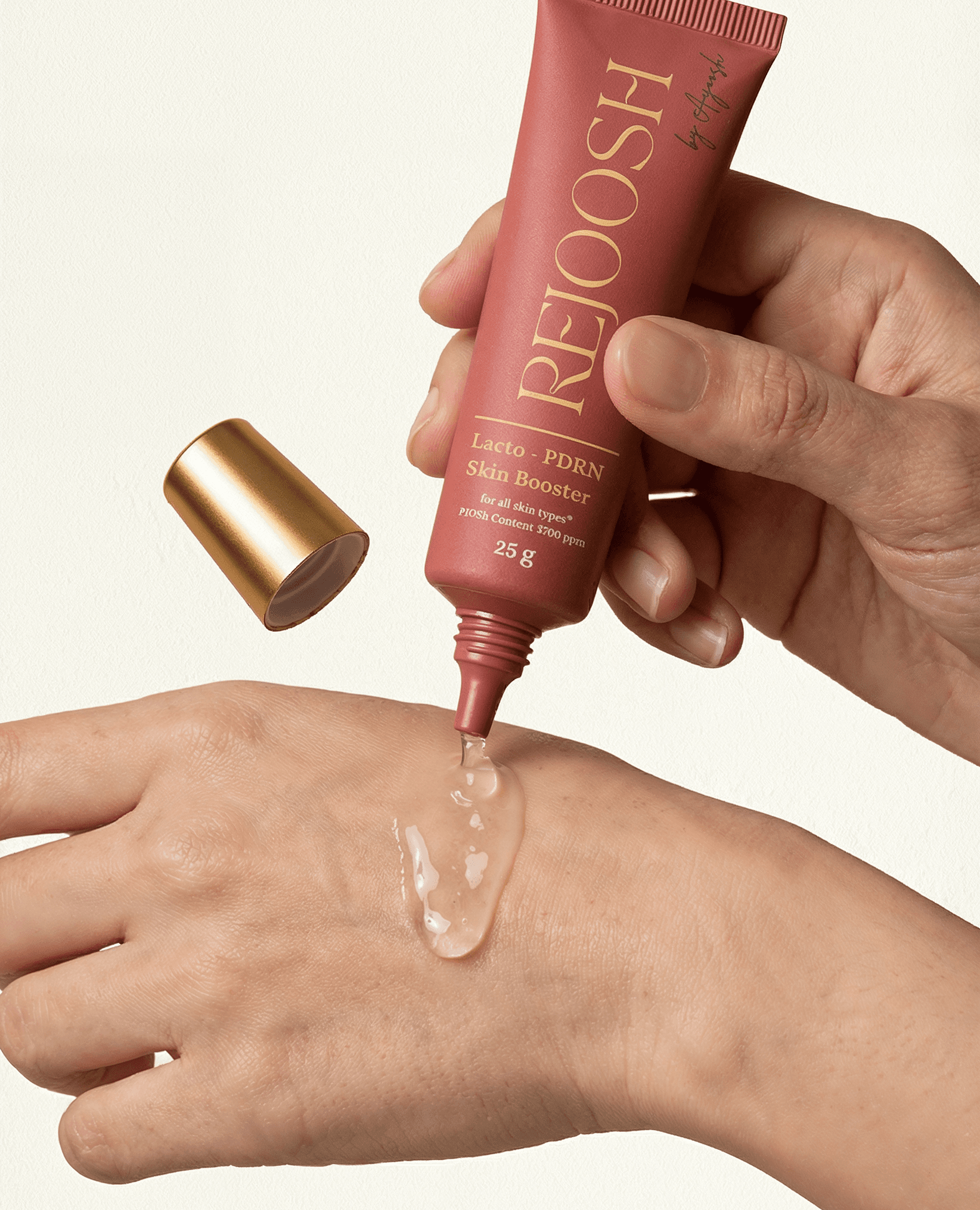
- Your treatment. One active. Not three. A vitamin C in the morning if you want brightness and pigmentation support; a peptide or PDRN booster if repair is the priority.
- Sunscreen. SPF 50 PA++++. Non-negotiable. A teaspoon for face and neck. In this climate it is not the last step of the routine, it is the reason for the routine.
Moisturiser is the negotiable one. In humid coastal heat, a good essence plus a modern sunscreen is frequently enough, and adding a cream on top is how people end up shiny by ten and congested by Thursday.
Evening: cleanse properly, then repair
- Double cleanse — but only when you need to. If you wore sunscreen or makeup, an oil or balm first to dissolve it, then a gentle water-based cleanser. If you wore neither, one cleanse is plenty. Double cleansing a bare face every night is how oily skin gets talked into producing more oil.
- Hydrating layer. Same toner or essence, same pressing motion.
- Repair. Evening is where the heavier lifting belongs: retinoids, PDRN, niacinamide, ceramides. Introduce actives one at a time, two or three nights a week, and give each one a month before you judge it.
- Seal. A moisturiser matched to your climate. In Gauteng winter that might be genuinely rich. In Durban summer it might be a gel.
What to quietly drop
- Physical scrubs. Micro-tears on melanin-rich skin invite pigmentation. If you want exfoliation, a low-strength chemical exfoliant twice a week does more with less damage.
- Sheet masks as a daily habit. Lovely, but they are a treat, not a step.
- Stacking actives. Vitamin C, an acid and a retinoid in one week is not an advanced routine, it is a compromised barrier waiting to happen — and the mark it leaves behind will outlast whatever you were trying to fix.
- Brightening products that are really bleaching products. If a claim sounds like erasure rather than evenness, put it down. The goal is your tone, even. Not a different tone.
Layering, in one rule
Thinnest to thickest, water before oil, and each layer on skin still slightly damp from the last. Wait long enough that a layer is absorbed rather than sitting wet — usually thirty seconds to a minute in heat, longer in dry cold. If your products are pilling, you are either using too much or not waiting long enough. It is almost never the products.
Give it eight weeks
Skin turns over roughly every four to six weeks, and pigmentation takes longer still. Six weeks of a simple routine done every single day will outperform six months of an elaborate one done when you remember. That is the whole secret, and it is why we keep our range short.
Start with the sunscreen. Add the essence. Add one treatment. That is a Korean routine, honestly adapted, and it will hold up in forty degrees.